

Names That Click: How to Choose the Right Domain Name
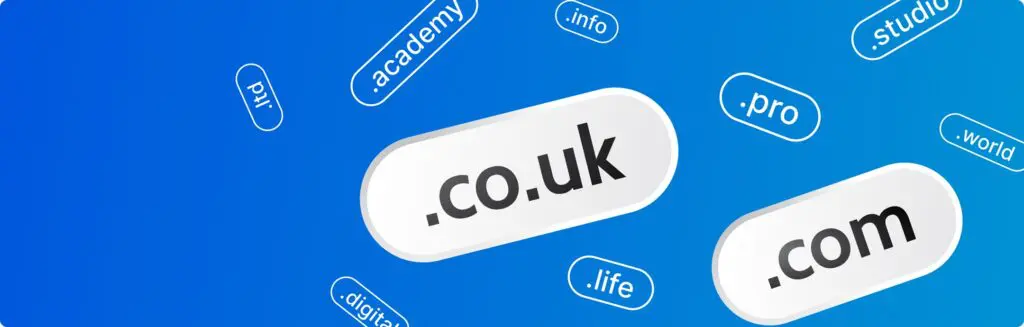
Choosing the right domain name is one of the fundamentals for online success. It’s the first thing many people see about your brand — and may even help to define it. The right choice is bound to make a big impact. But while buying a domain name can be surprisingly cheap and easy, it’s a challenge to up sticks and move home later on. So it’s important to get it right from the start. In this guide, we’ll go through some practical tips on how to pick a domain name that’s smart, affordable, and sure to make a lasting impression. What is a domain name? A domain name is a specific address that you enter into a web browser to visit a website. Every website has its own special domain name — much like any house in the street has its own postcode. To start with the basics, each domain consists of three main parts: the subdomain, the second-level domain, and the top-level domain (TLD) or domain extension. Many sites start with ‘www’ — the classic subdomain. The same age as Taylor Swift and at least equally as famous, we think you know what it stands for. Subdomains help organise a site, pointing to different sections. For example, a store might use “shop.something.com”, a blog could be on “blog.something.com”, and a mobile version might exist at “m.something.com”. At the heart of a domain name is the second-level domain. The core of the address, it’s what most people remember and associate with a website. It might be your brand name or a word that describes what you do. Last but not least is the top-level domain (TLD), like “.com” or “.co.uk”. The TLD shows users what type of site they’re visiting and, along with the second-level domain, is one of the most important things to consider when buying a domain. So what’s the difference between a web address and a URL? Well, they’re basically the same, but technically a URL also includes a protocol (“HTTPS”) at the start. And if it ever comes up in a pub quiz, URL stands for Uniform Resource Locator. Forward slashes can then create more subdirectories — but that’s more than enough detail for now! In short: when buying a domain, the two most important parts to think about are the middle bit and the TLD. To learn more about TLDs, take a look at: What is a Top-Level Domain (TLD)? How to choose a domain name What’s in a name? A rose by any other name would smell as sweet. Right? Well, Shakespeare wasn’t aiming to establish a successful online brand in 2025. One thing we can take from the Bard, however, is an awareness of how words and letters can affect an audience. Your domain is your online signature, after all. There are more than 350 million registered domain names out there today, according to the 2023 Domain Name Industry Brief Report. The most recognised extensions (gTLDs) include “.com”, “.org”, and “.net”. There are also the major country code extensions, such as “.fr” or “.jp”. In recent years, there’s been an explosion of new, weird and wonderful choices, like “.fun”, “.club”, “.london” or “.fit”. With new domain names registered at a rate of around 1 million each month, that total is expected to rise to over 550 million by 2026. As we’ll explore, the right choice of website address can have a huge impact. With that, here are our top tips for choosing the right one. Tips for picking the right domain ➤ Keep it short and sweet You want a domain name that’s easy to remember, say, and type. It should be straightforward and give potential visitors an idea of what your website is about. A domain that people can easily shout out will help with word-of-mouth recommendations and make it more likely for visitors to return to your site. 15 characters should be about the upper limit in most cases. But less is more. Avoid words that are prone to being misspelled, as well as hyphens or awkward sets of numbers. Special characters aren’t an option when choosing domain names (and that’s a good thing). ➤ Be on brand Try to find a brandable domain name. For many start-ups and small business owners just getting the ball rolling, it can be a smart strategy to come up with your brand name and domain name at the same time — they are likely to become, in effect, one and the same. Take the impact of domains like ‘JustEat.co.uk’ or ‘AutoTrader.co.uk’, for example. These are simple and direct, but also immediately inform visitors about the nature of the business. They create a loud and clear first impression. ➤ Be original Your domain name needs to be memorable and unique. Aim for a name that stands out. Certain words or structures in a domain name can trigger specific emotions or responses. A quirky and creative name can spark curiosity, for instance, while a prim and proper name can work to build a sense of trust and reliability. Choose an original turn of phrase that says something about your services or products. ➤ Check the competition Look at your competitors’ domain names. What patterns do you notice? Are there certain keywords they frequently use? Understanding the common trends in your industry can provide insights into what works (and what doesn’t). Tools like Namecheckr and Namechk are able to tell you not only if a domain name is taken, but whether or not the current status of username is available on social media. Be aware that there’s more to setting up an online business than simply owning a domain. Be sure to check for trademarks to ensure you’re not infringing on anyone else’s brand. That way, you should be able to avoid any legal issues or confusion. ➤ Make it future proof Changing your domain name later on can be a bit tricky. Or rather, it’s easy to buy a new domain name, but
Impact your business and join us for the Festival of Female Entrepreneurs

On Thursday 22nd October, 123-reg will be one of four headline sponsors of the annual Festival for Female Entrepreneurs, held at Colston Hall in Bristol. The event, run and managed by our good friends at Enterprise Nation, will play host to a day of information, education and inspiration that will help SMEs take their business to the next level. What is the Festival of Female Entrepreneurs? The event, run and managed by our good friends at Enterprise Nation, will play host to a day of information, education and inspiration that will help SMEs take their business to the next level. The Festival of Female Entrepreneurs takes place at Colston Hall in Bristol on Thursday 22 October. Access to the exhibition and networking space is completely free. Access to the networking area is £20, which will give you access to keynote talks and practical workshops from the UK’s leading female entrepreneurs and experts. There are only 250 tickets available for the keynotes and workshops so be sure to bag yours before they run out! Harnessing entrepreneurial spirit 123-reg is very proud to support the festival, especially when considering the growing numbers of females involved in start-ups in the UK. A report by the Office for National Statistics showed the number of self-employed women has increased by 34 per cent since 2009. By way of comparison over the past five years, the number of self-employed men has risen by just 15 per cent. Enterprise Nation’s 2014 Home Business Report found that of the 2.9 million homepreneurs in the UK, 64 per cent of them were women – equating to around 1.7 million women running businesses from home, contributing an estimated £180 billion to the British economy alone. What we have on offer The event which will be packed full of educative content aimed directly at SMEs will see 123-reg CMO, Kate Cox, deliver her top tips on how to start small businesses online. Additionally 123-reg SEO specialist, Roxana Stingu, will deliver a 30-minute workshop on the basics of SEO and the top tips for how small businesses looking to increase their rankings online. Additionally, 123-reg will have a presence at the event and will be on hand to help businesses get the answers they need to improve their online presence. For those that attend the event, we will be offering a free .com domain name with a free WordPress hosting or Website Builder package. The event has grown to become a mainstay of the South West’s business event landscape. Last year the event attracted over 700 attendees. For more information and to book your tickets, simply head to https://www.enterprisenation.com/festival So whether you have just set up your business or are looking for inspiration, the Festival of Female Entrepreneurs will have something for you. We look forward to meeting you! Join the social conversation using #FFE15
We’re ready for .it are you?
A new domain hits the 123-reg systems very soon, yet it’s strangely familiar. The .it extension is coming soon to 123-reg so you can enjoy the most descriptive computing domain name alongside all your favourites such as .com, .net and .co.uk. Now we know the .it domain is not new to everyone and we expect some of you probably already hold some .it domains but until now you couldn’t add them to your 123-reg portfolio. Since 123-reg is the UK’s leading domain market place for UK businesses we’re now adding the .it domain name extension, bringing an Italian flavour to our systems and helping our customers expand across the EU. If you don’t yet have a .it domain name you will soon be able to register yours via 123-reg in the usual way, showing availability on the extension when you search for any domain. If you already have a .it domain name, the introduction of the extension to our systems means you will be able to transfer it in and add it to your 123-reg domain portfolio. Owning a .it domain has a number of benefits. Not only does it protect your brand and provide you with a space for you to market effectively to customers in Italy but it also offers you the chance to highlight your company’s knowledge and expertise in the IT industry. You don’t need to be Italian to own one but you do need to be a resident of the EU to purchase a .it domain name. Otherwise the restrictions are few and far between. Any business setting up within the EU should be aware of the importance of .it domain names too as the following grid shows. Top European ccTLDs Germany .de approx 15,000,000 registrations United Kingdom .uk approx. 10,200,000 registrations Netherlands .nl approx. 5,000,000 registrations Russia .ru approx. 3,800,000 registrations Italy .it approx. 2,400,000 registrations There’s plenty of reasons why .it is a domain to be reckoned with and we think the addition of the .it registration to our systems is set to become extremely popular. So look out for our launch and remember to secure your .it domains.
URLs are your first line attack
URLs are important on-page SEO elements as we use them to travel from a page to another so they underpin your entire website. When you create a new site, create it with SEO in mind and try to come up with the best way to form URL structures for it. What Google says Google recommends using short URLs, thus trimming unnecessary parameters. In Google’s article on URL Structure it is mentioned that complex URLs can become an obstacle for crawlers and Googlebot may consume too many resources thus making it impossible to index all the content on your site. “Overly complex URLs, especially those containing multiple parameters, can cause a problems for crawlers by creating unnecessarily high numbers of URLs that point to identical or similar content on your site. As a result, Googlebot may consume much more bandwidth than necessary, or may be unable to completely index all the content on your site.” The ironic thing is that Google preaches but seems to be ignoring its own recommendations. Just take a look at all the Google Maps links, such as: http://maps.google.com/maps?f=q&hl=en&q=98115&ie=UTF8&z=12&om=1&iwloc=A What short URLs can do for your SEO Short URLs are easier to: Copy and paste Share over the Internet Email Write on a business card Write directly into your browser Spell when shared over the phone These are just a few of the benefits of having short URLs. However, even though the URL is short, it should be descriptive of the content the visitor will find on that page. For instance, here are some examples of good URLs from our website: https://www.123-reg.co.uk/domain-names/ https://www.123-reg.co.uk/vps-hosting/ How including keywords in your URLs can help Specialists recommend including in the URL the keyword we are targeting for that specific page. This will not only help with optimising the page for search engines, but also make it easier for any person to accurately deduce what information he will find on that page. Make use of Google’s Keyword Tool and SEOMoz’s Keyword Difficulty Tool as these are two great resources for your keyword research.
Secure your domain name: Why thinking about it could leave you weeping.
Ever had that Eureka moment? Maybe not, but you have probably had one of those ‘that’s a good idea’ moments but how often have you followed them through? With the ever growing importance of domain names in the modern world, thinking of a great slogan or concept should be followed straight away with a quick investment in securing the relevant domain names. Domain names are still probably the cheapest asset your business will ever acquire but probably the most valuable. Without them, your whole business premise could fail. Worse still, if you forget about securing them first off it is easy to get carried away with the rest of your brand and business building and completely miss out registering them. By the time you realise you may have told many people, some of which may be a bit more savvy and look to snap up the domains before you. A harsh lesson to learn, but one that even the ‘top’ business minds have faced. Over the weekend Jade Nash faced the very same in front of millions of viewers of the BBC The Apprentice. When quizzed about the four domain names listed in her business plan, interviewer Mike Soutar, CEO of Shortlist Media, revealed that , one of them chooseenergysupplier.co.uk, was not registered to her. In fact, he’d registered the same for himself when he discovered that fact and offered to sell it back to her. A major faux pas, especially when attempting to show her cutting edge business know-how. In her case, with Souter now offering it back at cost price, the only loss to Jade looks likely to be the loss of face on international tv, but in the real world, people face massive costs, stress and hassle by allowing somebody else to nip in and register a domain name before them. With our online domain search tool, you can secure your domain name as soon as you think of it. It needn’t be people overhearing your conversations either who may ‘steal in’. If you came up with the idea, there’s a good chance somebody else has or very soon will too. Especially around big events such as last year’s royal wedding and the recent jubilee we always see a flurry of domains being bought in speculation so it is very easy to miss out. There’s no excuse given the low cost and convenience of buying through 123-reg for you to miss out on registering your suitable domain names. They are affordable enough too to justify some speculation right across the domain range. Don’t forget your idea may yet become an international sensation. Don’t miss out as one 123-reg customer once recalled to this blogger, by choosing only to register the .co.uk domain and overlooking the .com option. Now five years past and a multi-million turnover harnessed they are having to pay ‘over the odds’ to purchase the .com version to help expand their empire beyond the uk. Have you ever ‘missed out’ on a domain name? Have you a tale of domain names secured but not turned to success until years later? Please let us know.
I’m a .Pro you know
Taking countless exams and years of study – often in your ‘spare time’ not only shows dedication but also a high level of specialism in your chosen subject. That’s why becoming a qualified professional is something 1) you should be proud of 2) potential customers should be able to identify immediately. In domain terms now there is a badge of honour that can instantly show your professional status. The .pro domain extension is designed for professionals to promote their knowledge and business know-how to potential customers. Whether you use simply your full name (johnsmith.pro) or you go more descriptive (johnsmith-surveyor.pro) there will be no doubting your qualification status and expertise. At just £14.99 a .pro domain is a very affordable away of gaining trust from your potential customers and promoting your professional status to those who might want to know.
New domain name applications are open now
If you believe the hype, 2012 could be the year of new domain names. That’s because plans for the liberalisation of the domain name market – which were discussed and debated for years – are finally being put into practice. This month saw applications open for the creation of new domain name extensions. Think .london, .microsoft, .coke or .sport – anyone can apply to create a new domain name suffix. New domains, but not for everyone Applications close in April, after which ICANN (the organisation that manages the domain name system) decides who should be able to set up and run new domain names. Of course, it’s not for everyone. The application process is complex and expensive. It costs $185,000 just to put an application forward, and applicants also have to demonstrate that they can effectively set up and run the new domain name extension. For cost reasons alone, expect to see applications limited to big name corporations. Some pundits have suggested Facebook could be among them, simply in order to give every Facebook user their personal web address: http://yourname.facebook. Industry experts Verisign reckon there could be 1,500 applications. Of most interest to smaller businesses and individuals will be any non-branded terms that are opened up for public registration. Perhaps your business would like a .local or a .london address. Are they better than .com? The truth is it’s too early to say what impact these new domain names will have. Some big brands have confirmed that they’re definitely not interested, preferring to stick with their tried, tested and highly-recognisable .com domain names. That’s fine if you already own the .com domain name of your dreams. But with prime domain names becoming rarer, new extensions could be the best way to ensure there are enough good domain names for everyone. Of course, we’ll be keeping a close eye on this over the next few months. It’s too soon to say what new domains will be created or how they’ll be used. But we plan to expand the range of domain names we offer to include any exciting new extensions – so you can still enjoy the wide choice you’ve come to expect from 123-reg.
.uk Industry – Nominet by Numbers
Nominet has launched its first edition of The Domain Business, an industry report from the .uk registry on the exciting state of the domain name industry – and there are some interesting statistics. Did you know? .uk is the second largest ccTLD (9.7 million domain names) Nearly 1 in 4 of .uk business websites are e-commerce enabled 43% of .uk domains in use are for business websites 5% of those .uk websites are just a single page The uptake of .uk domains continues to rise (growing at over 8% per annum) as does the global domain name population (now at 218 million). Despite the uk economy suffering crisis the .uk economy seems to be competing very well, emphasising the role online business will play in helping the economy improve and stablise. As well as more pie-charts, bar and line graphs than we’ve since we were at school, the statistics are backed up by some incisive comments from those inside Nominet and experts in the domain name field. If you are thinking of riding on a domain trend, or simply interested in the quirks of what seems to work best in terms of domain names, The Domain Business is well worth a read.