

Search engine optimisation (SEO) is all about improving your website so that it appears higher in search engine results when people look for businesses, products, or services like yours.
Broadly it’s about making sure your website is clear, relevant, and easy to understand — for both your visitors and for Google.
Done well, SEO helps the right people find your business at exactly the moment they’re looking for what you offer.
Why SEO matters for your business
When someone searches for a product or service online, they’re already interested; they just need to find the right business. SEO is what helps that business be yours.
The majority of people don’t look past the first page of search results. If your website isn’t ranking well, you’re likely missing out on visitors who don’t even know you exist. SEO changes that by helping your site show up where it counts.
Unlike paid advertising, SEO builds visibility over time. The effort you put in today, improving your content, your structure, your links, keeps working for you long after. It’s one of the most cost-effective ways to grow online.
For small businesses especially, good SEO can level the playing field. You don’t need a huge budget to appear alongside bigger competitors. You just need a website that’s set up properly and content that genuinely answers what people are searching for.
How search engines work
To understand SEO, it helps to know what search engines are actually doing.
When you type a query into Google, it doesn’t search the whole internet in real time. Instead, it searches its own index: a vast catalogue of web pages it has already crawled and analysed.
Search engines use automated programmes called crawlers (or spiders) to constantly scan websites, follow links, and record what they find. Based on hundreds of signals, Google then decides which pages are most relevant and useful for any given search.
This includes things like:
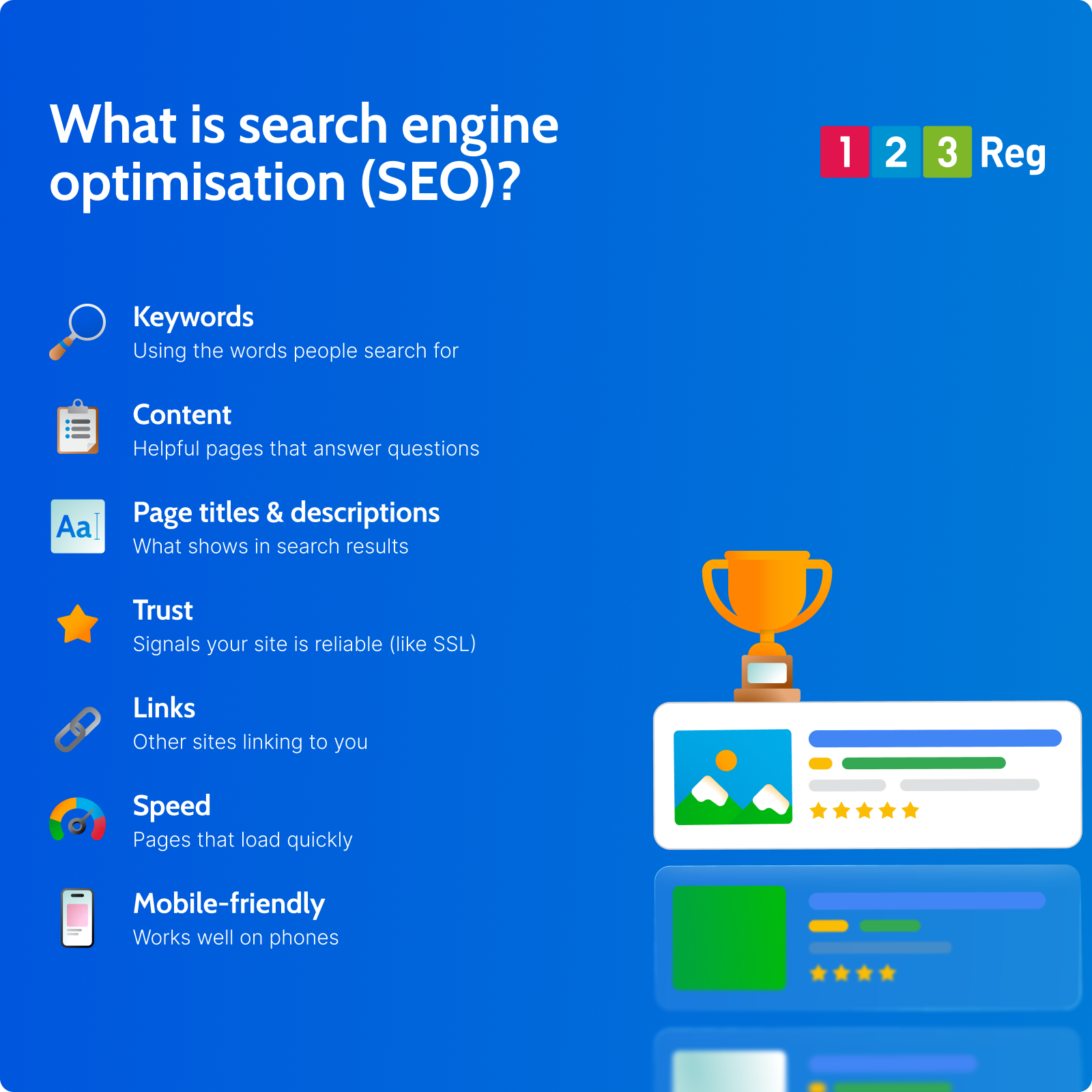
✓ The words and topics on your page
✓ How well your site is structured and how fast it loads
✓ Whether other reputable websites link to yours
✓ How your site performs on mobile devices
✓ How people interact with your content once they land on it
SEO is the practice of optimising for these signals — so Google can find, understand, and trust your website.
Keywords: matching what people search for
At the heart of SEO is understanding what your customers are actually typing into search engines, and making sure your website reflects that language.
These search terms are called keywords, and they’re the bridge between what someone is looking for and the content on your site.
☐ Short-tail keywords are short (usually one-or-two word) search terms, like “B&B” or “Devon B&B”. They attract high search volumes but also face a lot of competition, making them harder to rank for, especially as a smaller business.
☐ Long-tail keywords are longer, more specific phrases that reflect exactly what someone is looking for, like “Bed & breakfast with sea views in Devon”. They tend to have lower search volumes, but the people searching them are usually further along in their decision-making and more likely to convert.
Once you’ve identified your keywords, the goal is to use them naturally in the right places:
✓ Page titles and headings
✓ The main body of your content
✓ Image descriptions (alt text)
✓ Page URLs
✓ Meta descriptions (the snippet shown in search results)
For more, check out: SEO Essentials – The A-Z SEO Guide
The main areas of SEO
SEO covers a few different areas, each of which plays a role in how well your site performs in search.
On-page SEO
On-page SEO is about the content and structure of your website itself. This includes using the right keywords, organising your headings, and making sure each page has a clear focus.
Your page title is often the first thing both Google and a potential visitor sees, so it needs to be accurate, relevant, and compelling.
Your meta description (the short snippet shown beneath your link in search results) won’t directly boost your ranking, but a well-written one can make the difference between someone clicking through or scrolling past.
Technical SEO
Technical SEO is about how well your website is built and how easy it is for search engines to crawl.
✓ Page speed: Fast-loading pages are great for customers, and have an effect on Google rank, too.
✓ URL structure: clean, readable URLs help search engines understand what each page is about and make your site easier to navigate
✓ Mobile-friendliness: with more than half of all searches happening on phones and tablets, Google prioritises sites that work well on smaller screens
✓ SSL Certificates: the padlock in your browser bar signals to both visitors and Google that your site is secure, and sites without one are actively flagged as untrustworthy
Off-page SEO
Off-page SEO is about your reputation beyond your own website. The most important factor is backlinks, links from other websites pointing to yours, which act as a vote of confidence and signal to Google that your content is worth ranking.
Trust plays a big role too. Google looks at the credibility of the sites linking to you, your consistency across the web, and whether your business information matches up across directories and listings.
A few links from well-regarded, relevant sources are worth far more than dozens from low-quality ones.
Local SEO
Local SEO is especially important for businesses that serve a specific area. This includes optimising for location-based searches, keeping your Google Business Profile up to date, and earning local reviews.
You don’t need to master all of these at once. Starting with the basics of on-page and technical SEO will already put you ahead of many competitors.
See also: Local SEO in 10 – How Do I Get My Business Found Online?
Why content is still king
Search engines reward websites that genuinely help people. That means the quality of your content matters just as much as any technical tweak.
Good SEO content answers real questions clearly and completely. It’s written for your audience first, with search engines in mind second. The more useful and relevant your content is, the more likely Google is to rank it, and the more likely visitors are to stay, engage, and convert.
AI is changing how people search
Search isn’t just blue links anymore. Google’s AI Overviews now answer many queries directly at the top of the page, and tools like ChatGPT and other AI assistants are becoming a first stop for many people looking for recommendations and information.
That means being visible online now extends beyond traditional search results. The businesses that appear in AI-generated answers tend to be those with clear, well-structured, trustworthy content, which makes good SEO more important, not less.
For more, check out: How to Show in AI Search Answers and How to Get Your Business Found in Google AI Mode
Getting started with SEO
SEO can feel overwhelming at first, but you don’t need to do everything at once. Start with the foundations and build from there.
With the right domain name, a well-structured content, and content that speaks to your audience, SEO is well within reach for any business.