

Running an online business today, big or small, the chances are many of your customers will be looking for answers from Google AI Overviews and ChatGPT before they ever click through to your website.
This article shows you how to check whether your brand actually appears in those answers and how to track it. We’ll also look some of the best paid tools out there if you want to go a step further.
Key takeaways
- ☑︎ AI search isn’t about search rank — it’s about being included in the answers.
- ☑︎ Getting seen comes from trusted sources talking about you, and AI choosing to recommend your brand over others.
- ☑︎ Audit your visibility by running a small set of repeat prompts across Google AI Overviews and ChatGPT
- ☑︎ A simple spreadsheet and regular prompt tests reveal obvious patterns.
- ☑︎ Paid tools may be able to help you track visibility at scale. We’ve listed some, but they’re probably not essential.
What is AI search visibility and why it matters
Search has changed forever. While customers are still using Google, more than ever they’re seeing AI‑generated answers at the top — or heading straight to tools like ChatGPT for a faster, more conversational response.
Those answers usually pull together just a few brands, a couple of websites, and sometimes a direct recommendation. It’s no longer just about appearing in a list of links. It’s about being part of the answer people see, and how your brand is positioned within it.
AI search visibility is how often your brand appears inside these AI-driven answers. Sometimes called GEO (Generative Engine Optimisation) or AEO Answer Engine Optimisation, we’ll use AI search visibility in this guide.
How AI tools are changing search behaviour
Since rollout, Google AI Overviews now reach over 2 billion monthly users worldwide, with more people seeing AI-generated answers at the top of search results before they scroll further down the page.
Because AI answers often provide a full response directly on the results page, industry analysis shows that clicks to traditional organic listings are starting to drop, especially for top positions, as fewer people need to click through to websites to find what they’re looking for.
In the UK, signals show brands are increasingly being surfaced inside AI answers, sometimes more often than they’re being clicked in traditional listings. All in all, it points to a clear shift in how people discover businesses online, whether they’re big or small.
What good AI search visibility looks like
AI search visibility is how often and how clearly your brand appears in AI answers.
It’s about being part of the answer people see — mentioned, linked, or recommended when someone asks a relevant question. That means:
✓ Consistent visibility across AI tools
Good visibility means showing up regularly when people ask related questions. If your brand appears in one AI tool but not others, or only sometimes, your visibility is likely uneven.
✓ Getting ahead of competitors in recommendations
It’s not just about being included — it’s where you sit. If competitors are consistently mentioned before you, it often means they’re seen as a stronger or more relevant option.
✓ Being backed by trusted sources
AI tools tend to rely on sources they trust, such as industry sites, review platforms, and well-known publications. If your brand appears in these places, it’s more likely to be picked up.
✓ Being recommended, not just listed
There’s a difference between being mentioned and being suggested. Strong visibility means AI tools don’t just list your brand — they actively recommend it as a good fit for the query.
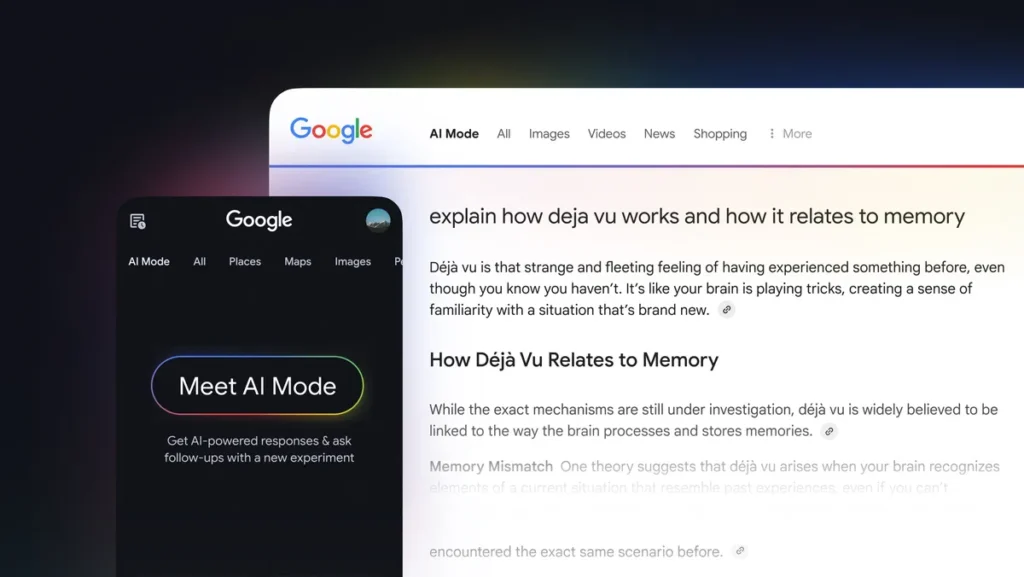
See also: How to Get Your Business Seen in Google’s New AI Mode
How your brand shows up in AI answers
When your brand shows up in an AI answer, it usually happens in one of three ways: it’s mentioned in passing, it’s cited as a source, or it’s actively recommended as an option.
Each one carries a different level of impact, and not all of them are equal.
Mentions vs citations
A mention is just your name appearing in the answer. A citation is when the AI pulls information from your website or content and references it as a source.
Citations tend to carry more weight because they show the system is directly using your material, not just repeating your name.
AI training data vs real-time sources
In other words: what AI already knows, compared to live sources it may (or may not) pull from the web. AI tools don’t browse the internet in real time like a human; they rely on a mix of training data, trusted websites, and sometimes live search.
That means your visibility is often shaped by content that is easy to find, clearly structured, and widely referenced across the web.
Search rankings vs AI visibility
Ranking well on Google doesn’t automatically mean you’ll show up in AI answers.
✓ clearer or more direct explanations from other sources
✓ content that appears more frequently across the web
✓ pages that are easier to summarise
So even strong SEO performance doesn’t guarantee AI visibility (though it still certainly helps).
Your brand vs competitor visibility
If competitors are being mentioned more often, it’s usually because they’re referenced more widely across trusted sites, easier for AI systems to understand and summarise, and more consistently linked to certain topics or services.
In short, AI tools tend to favour the brands they see most clearly and most often across the web.

For more, check out: How to Show in AI Search Answers – 8 Top Tips for Business Owners
How to track your business in AI answers & overviews
The goal is simple: to see how often you show up, where you sit in the answer, and what kind of content or sources are shaping those mentions.
With a small set of repeatable checks, you can start spotting patterns and gaps without major tech or third-party tools.
Step 1: Run simple prompt tests
The simplest way to check your visibility is to ask AI tools the same types of questions your customers would.
You don’t need anything fancy to start with.
A simple log of prompts and results is enough to spot patterns over time — especially whether you’re appearing consistently or being missed entirely.
Think in real customer questions rather than keywords. For example, what someone would actually type when comparing options or looking for a recommendation. Like:
✓ “Best [your service] in the UK”
✓ “Top alternatives to [competitor]”
✓ “Recommended [product/service] for small businesses”
Step 2: Check across multiple AI tools
Start by asking AI tools the same kinds of questions your customers would use.
✓ ChatGPT
✓ Perplexity
✓ Claude
✓ Google AI Overviews (via Google Search)
✓ Microsoft Copilot (built into Windows 11 and Microsoft 365)
Each one pulls from slightly different sources, which means your visibility can change from tool to tool.
Run the same prompts across different tools to see how often you appear.
Step 3: Understand what to look for
AI visibility isn’t shaped by one thing. It’s a mix of how often you show, where you show, and what’s influencing those answers.
There are four simple signals that shape how visible a brand is in AI answers: Presence, Frequency, Position, and Source.
Looking at these together helps you see not just if you show up, but how you show up, and what’s driving it.
Key questions for AI search visibility
| Key question | What it means | Why it matters |
|---|---|---|
| Presence | Whether your brand appears in AI answers for relevant topics. | Do we appear when people ask about topics we care about, or are we missing completely? If your brand isn’t mentioned at all for key searches, that’s a clear gap. |
| Frequency | How often your brand appears across different questions and tools. | Are we showing up regularly, or only now and then? If visibility is inconsistent, it’s harder to stay top of mind. |
| Position | Where your brand appears in AI answers compared to others. | Are we mentioned early, or only after other brands? If competitors are suggested first, they’re more likely to be chosen. |
| Source | The types of sources the AI pulls from when mentioning your brand. | Are mentions coming from trusted, up-to-date sources, or weaker ones? Stronger sources make it more likely your brand is included. |
Step 4: Keep a simple log
You don’t need anything advanced — just a basic record of what you’re seeing.
Keep it simple with columns like:
✓ Prompt used
✓ AI tool tested
✓ Whether your brand appears
✓ Which competitors show up
✓ Notes on the answer
Over time, this gives you a clear picture of where you stand.
Step 5: Build consistency over time
The real value comes from repeating the same checks over time. You’re looking for patterns, not one-off results.
Start small and build up from there. You’re looking for shifts over time — not perfect coverage from day one.
Step 6: Review on a regular cadence
For most businesses, a monthly check is enough to begin with.
If you’re in a more competitive space or actively working on content, weekly checks for your core prompts will give you a clearer picture of change.
What tools can I use for tracking AI search visibility?
If you want a deeper view of how your brand shows up in AI answers, there are now a growing number of paid (or ‘freemium) tools that can help.
Some are full paid platforms with reporting and competitor tracking, others are lighter freemium tools that give you quick snapshots from prompts.
You don’t need these to get started. The manual checks above are enough to spot patterns. But these tools can save time, help you track at scale, and make it easier to monitor changes over time as AI search keeps evolving.
Tools for tracking AI search visibility
1. Semrush
What it is: Semrush is a well-known SEO tool that now includes features for tracking AI search visibility.
What it does: It tracks how often your brand appears in AI answers alongside your normal Google search performance, so you can see how your presence is shifting between classic search and AI-powered results.
2. Ahrefs
What it is: Ahrefs is an SEO platform that includes a tool called Brand Radar for tracking mentions.
What it does: Brand Radar shows where your brand is mentioned across AI tools and across the wider web, giving you a clear picture of how often you’re being talked about and where.
3. Keyword.com
What it is: Keyword.com is a rank tracking tool that now also covers AI search results.
What it does: It combines normal keyword tracking with AI overview checks, so you can see how your brand shows up in both search results and AI answers.
4. Promptwatch
What it is: Promptwatch is a tool built for tracking how your brand shows up in AI search.
What it does: It lets you monitor prompts, brand mentions, and where your content appears inside AI answers. It’s useful if you want to see what’s actually being said about you in AI tools.
5. Peec AI
What it is: A tool for tracking how visible your brand is across AI search tools.
What it does: Peec AI shows your share of voice and compares your visibility against competitors using the same prompts, so you can see who’s showing up more often.
6. Otterly.AI
What it is: Otterly.AI focuses on tracking how often your site is used in AI answers.
What it does: It shows when your website is cited as a source and helps you understand which pages or content AI tools are pulling from.
7. Nightwatch
What it is: Nightwatch is a rank tracking tool that also includes AI search monitoring features.
What it does: It blends traditional SEO tracking with AI visibility data, so you can see how your brand performs across both search and AI answers.
8. Profound
What it is: An advanced tool designed for tracking AI search trends at scale.
What it does: Profound looks at prompt trends and brand visibility across AI tools, and is often used for deeper analysis of how brands are showing up in AI search.
See also: 2026 Business Trends and Tips Every Owner Should Know
Remember: SEO, ads and reviews still matter
Even as AI answers change how people find things, the basics still matter — especially for smaller online businesses.
Good SEO and strong customer reviews help search engines and AI tools understand and trust your brand, making it more likely you’ll show up or get mentioned.
Locally focused pages and up-to-date listings help you appear for “near me” searches, which can help you get seen by both humans and AI. Be sure to:
☑︎ Set up and keep your Google Business Profile up to date
☑︎ Stay on top of customer reviews and encourage new ones
For SEO tips, see our guide: Local SEO in 10 – How Do I Get My Business Found Online?
For immediate reach, you can always choose Pay-Per-Click (PPC) ads. Our Google Ads Guide explains how to get started with paid search.
Wrap up
AI search is already changing how people discover and choose businesses. The key thing is understanding whether your brand is showing up in the answers people actually see. Paid tools do exist, but you probably don’t need them to started — a few simple checks will give you a clear picture of where you stand and where you’re being missed.