
Domain names are digital real estate — and some are worth millions. The most expensive web address ever sold was Cars.com, valued at an astounding $872 million. While it’s unlikely that you’ll have a domain in your portfolio worth quite so much, there’s still a good chance you could sell your domain names for a tidy profit.
But selling is only one side of the story. Many people buy domain names to hold onto ideas, protect their brand, or invest in names they think could grow in value over time. Because once a domain is taken, it’s gone, and the best names don’t stay available for long. That’s why many people start by registering a few strong ideas early, while they’re still affordable.
Here’s what you need to consider when buying and selling domain names.
Key takeaways
-
- ☑︎ Short, memorable, relevant domains are valuable — you can find thousands of options with 123 Reg, whether buying or selling.
- ☑︎ You can sell domains via brokers, auctions, or privately, using secure payments like escrow (a service that holds money until the domain is safely transferred).
- ☑︎ A domain is only worth what someone is willing to pay, so research similar sales.
- ☑︎ Buying domains early can protect your brand, hold ideas, or create future opportunities.
- ☑︎ Domains usually grow in value when used to build a website with quality content and create a matching professional email address.
Why people buy domain names
People don’t always buy a domain just to build a website right away.
Some buy them to:
✓ Hold onto a great idea for later
✓ Protect their brand name
✓ Try out a side project
✓ Sell on for a profit later
Others use their domain right away for a website or a professional email address that matches their name.
Either way, owning the right domain gives you options — whether you decide to use it, keep it, or sell it later.
See also: The Most Expensive Domain Names Ever Sold
What part of a domain name can I buy and sell?
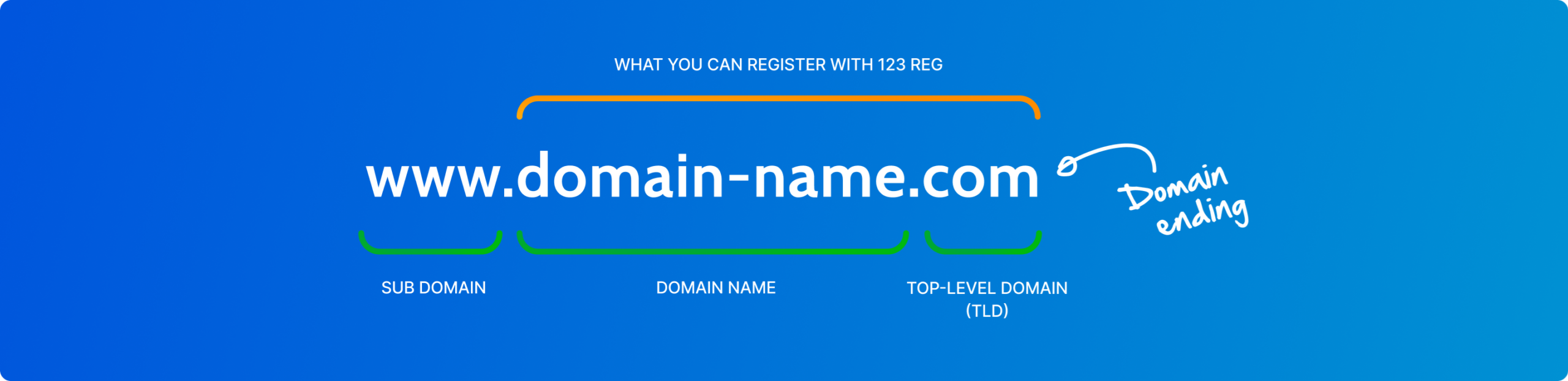
When you register a domain, you’re buying the full name made up of two parts: the Second-Level Domain, in the middle, and the Top-Level Domain (TLD) or extension, at the end.
For example, in your-great-idea.co.uk, “your-great-idea” is the Second-Level Domain and “.co.uk” is the TLD. You can mix and match but you can’t buy these separately — they come together as one domain.
A good domain name should always be:
✓ Short and easy to spell
✓ Easy to say out loud
✓ Relevant to what you offer
For more, check out: How to Choose the Best Domain Ending in 2026 and How to Buy a Domain Name?
Once it’s yours, a domain can be used for your website, your matching professional email address, or both, and keep it by renewing it each year.
There are over 400 different domain endings to choose from with 123 Reg, so you’re bound to find one that fits what you do and who you want to reach. Whichever you choose, your domain ending helps shape how your site is seen, and like the rest of your domain, it needs renewing to stay active.
How to know the value of a domain name
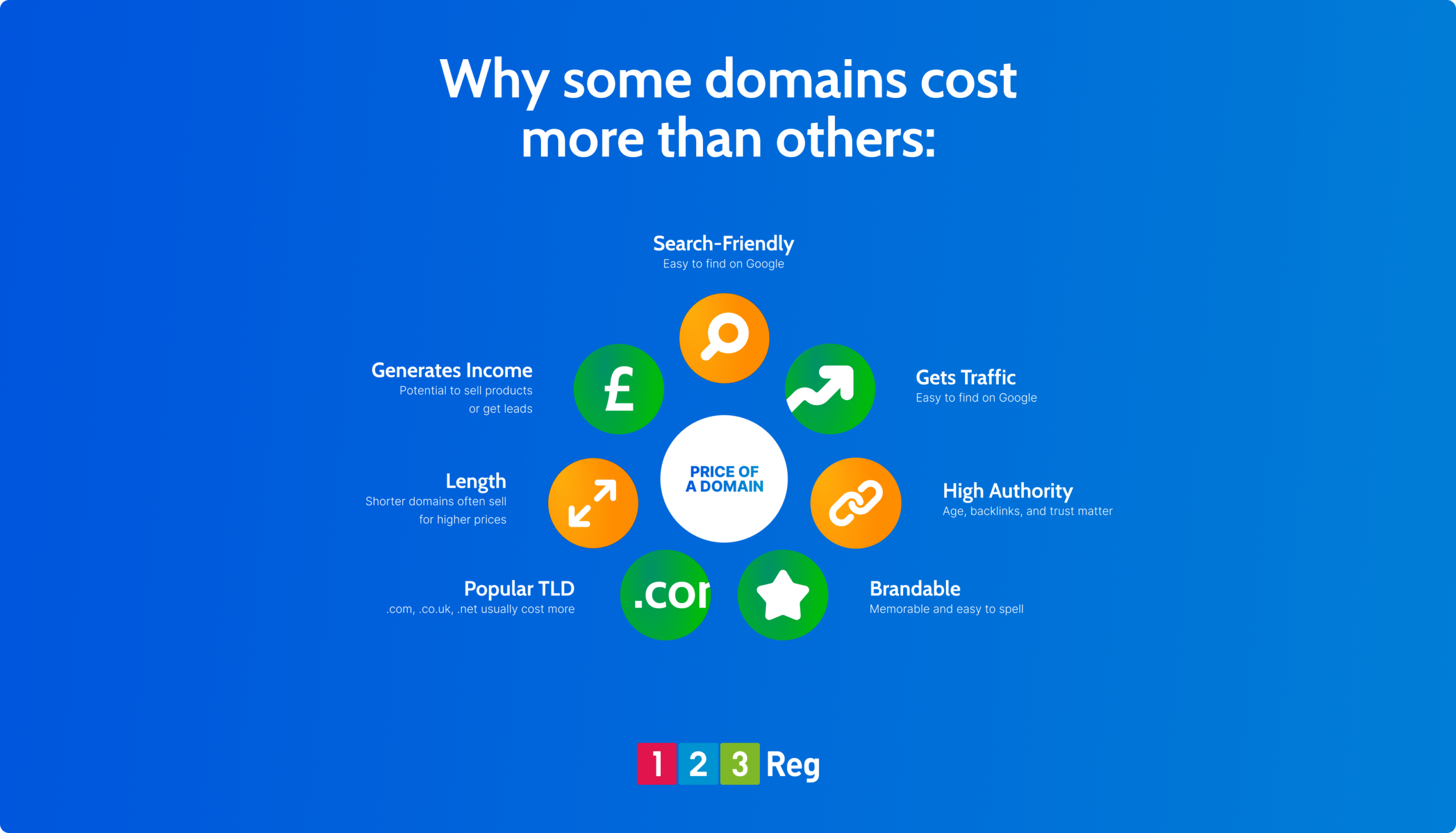
How much is your domain worth? Domain prices vary based on how desirable the name is. Key factors include:
☑︎ Length. Shorter domains are easier to remember, type, and in short supply, so they cost more.
☑︎ Brandability. Names that are easy to say and remember are more appealing and stand out.
☑︎ Keywords & traffic. Domains with popular keywords attract natural visitors.
☑︎ TLD recognition. Recognised endings like .com or .co.uk carry trust and demand more.
☑︎ Existing authority. Domains with prior use, backlinks, or SEO history can fetch a higher price.
☑︎ Income potential. Domains already generating revenue sell for more.
Remember: A domain is only worth what someone is willing to pay. Valuation tools are a guide, not a guarantee. If you’re just getting started, it can be worth registering a few strong, low-cost domains and seeing how interest builds over time.
While you can make an educated guess, tools and past sales data can give you a rough idea of what buyers might pay. GoDaddy, our partner company, offers a domain valuation tool to help you work out the likely value of a domain.
How to make profit with domain flipping
Flipping domains means buying names at a lower price and selling them later for a profit.
Some people do this as a side project, while others build up a larger portfolio over time. In some cases, experienced domain investors can make a steady income each year.
But it’s not just about reselling. A domain can become more valuable if you:
☐ Build a simple website
☐ Add content or traffic
☐ Use it for a professional email
Even small improvements can make a domain more appealing to buyers later on.
What is domain parking?
Domain parking is when you register a domain but don’t build a full website on it right away. You can still show it’s for sale, display a simple page, or earn a little from ads while you decide what to do with it.
Learn more about domain parking in our article: What is Domain Parking?
How to sell your domain name
When selling a domain, there are two main decisions:
☐ Where you’ll list it
☐ Whether to use a fixed price or auction
There are plenty of domain broker services out there. 123 Reg doesn’t offer a broker service directly, but we’ve partnered with GoDaddy to help you list and sell your domains.
Other platforms include Sedo, Flippa, and Afternic.
Broker platforms usually charge a commission, but they give you access to a large audience of buyers.
You can also sell privately or through sites like eBay, but you’ll need to handle promotion and communication yourself.
For most domains, a fixed price works well. Auctions tend to suit higher-value names where multiple buyers may compete.
1. Let people know your domain is for sale
The more potential buyers you can attract to your domain the better, so it makes sense to let people know that your domain name is up for sale.
There are a number of ways you can do this. Most domain broker services will ensure that your website is advertised for sale when someone visits the URL. Your domain name will also be displayed on the broker’s site, although people may have to search to find it.
You can also let people know that your domain is for sale via social media, domain investing forums and email outreach. Note: It’s probably only worth letting domain investing forums know you’re selling a domain if it’s an extremely premium domain that will attract a lot of attention. Email outreach works well for domains linked to professional services.
2. Prepare your domain listing
At a minimum, your listing should include:
☐ The domain name
☐ The price (or starting bid)
If the platform allows it, add a short description covering:
☐ What the domain could be used for
☐ Any past use
☐ Traffic, SEO history, or revenue (if relevant)
Clear, simple descriptions help buyers quickly see the potential.
3. Arrange a payment option
Domain sales can involve large amounts, so it’s important to use a secure payment method.
Most broker platforms handle payments for you using escrow. This means:
- The buyer sends payment to a third party
- The domain is transferred
- The funds are released once everything is complete
This protects both sides and is the most common way domain sales are handled.
If you’re selling privately, using an escrow service is strongly recommended.
How to transfer a domain name
Once your domain is sold, you’ll need to transfer it to the new owner.
The general process is:
- Contact your domain provider and request a transfer
- Confirm you own the domain
- Approve the transfer
- The domain moves to the new owner
- Payment is released from escrow
Note: If your domain was registered or transferred in the last 60 days, it won’t be eligible for transfer yet due to standard rules.
Why might a domain transfer fail
A domain transfer may fail if:
☐ The domain is locked
☐ Contact details don’t match
☐ The domain is less than 60 days old
☐ There are restrictions or holds in place
These checks are there to help prevent unauthorised transfers.
How long do domain transfers take?
Most transfers complete within a few minutes to a few days, but in some cases can take up to 7 days.
To learn how to transfer a domain name to 123 Reg, check out: Domain Transfer Guide – When to Switch and How to Do It
Wrapping up
If you want to sell a domain, start by working out how much it’s worth. Next, choose a safe and secure way to sell it. Most people use an established domain broker service. Finally, make sure you understand the payment process and how to complete the domain transfer to the new owner.