
An SSL certificate is a small digital file that secures the connection between your website and your visitors. It encrypts the data passing between them, keeping sensitive information private and protected.
If you’ve ever noticed “HTTPS” and a little padlock icon in your browser’s address bar, that’s an SSL certificate at work.
Even if your website doesn’t collect sensitive information, SSL still matters. We’ll explain why below.
What does an SSL certificate do?
When someone visits your website, information travels back and forth between their browser and your server.
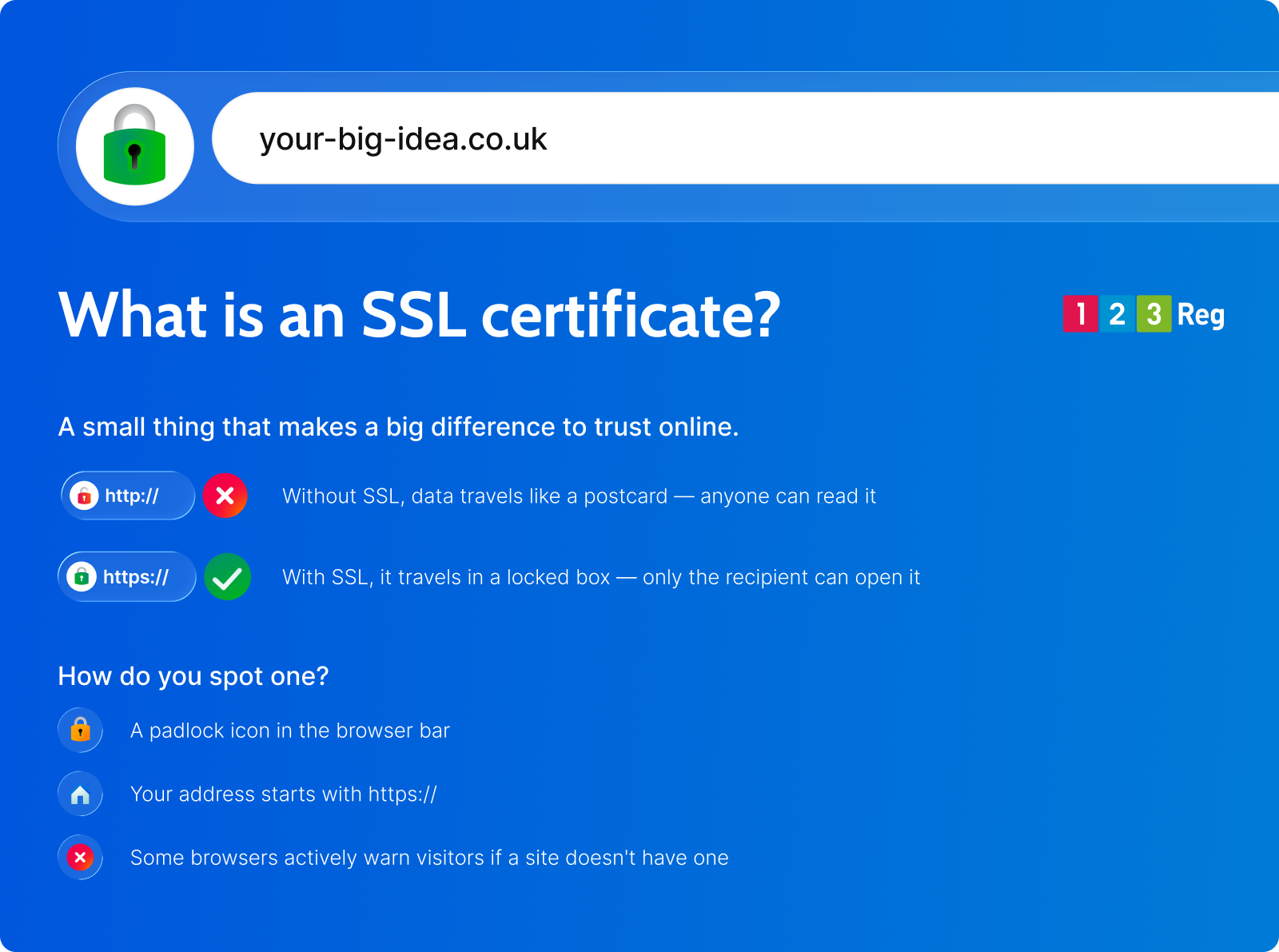
Without SSL, that information can be intercepted by a third party. With SSL in place, it’s encrypted, meaning it can only be read by the intended recipient.
This is especially important for:
✓ Online shops taking payment details
✓ Contact forms collecting personal information
✓ Login pages handling usernames and passwords
✓ Any website where visitors share data
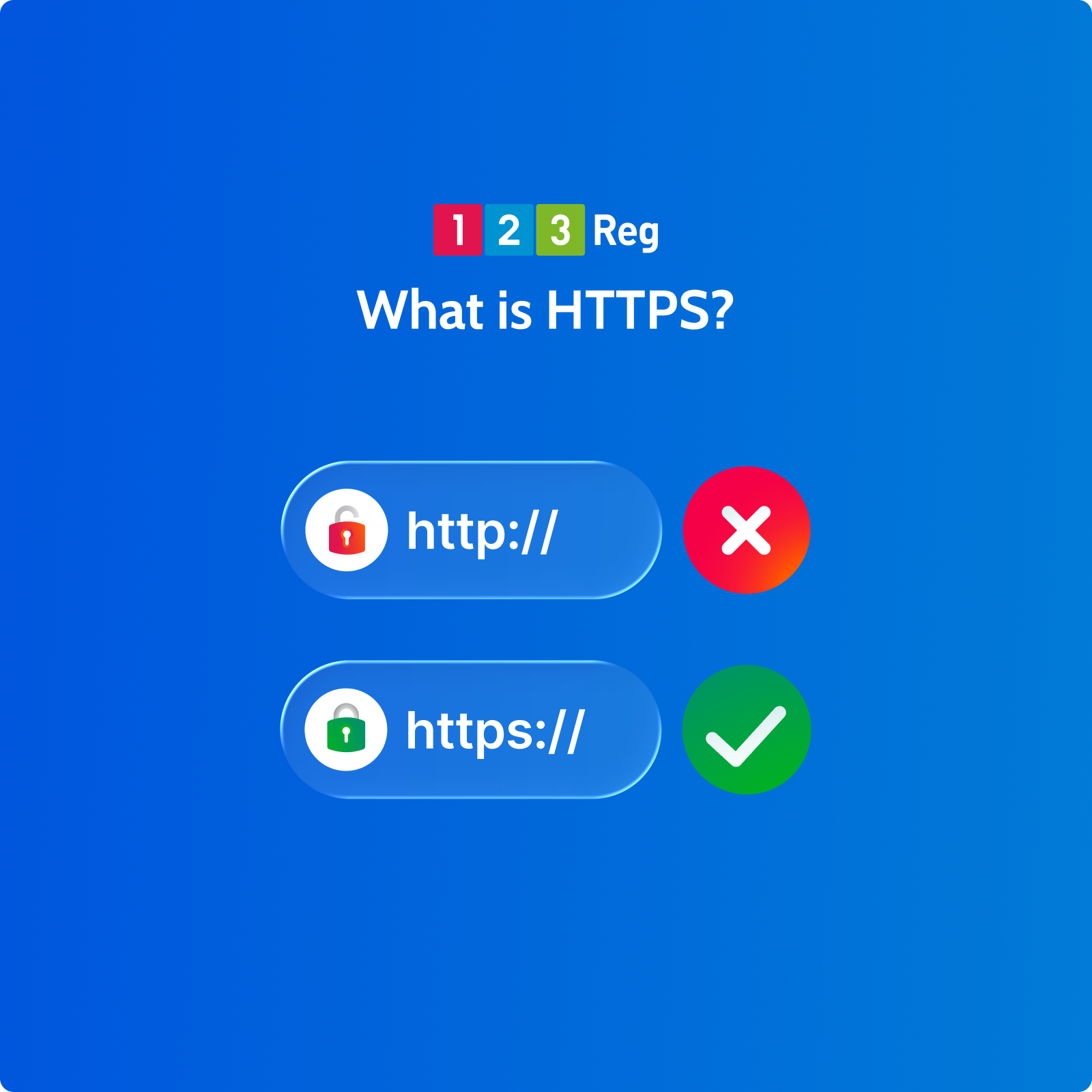
You can tell whether a site has SSL just by looking at its web address. Sites starting with https:// are secure. Sites starting with http:// are not.
HTTP vs HTTPS: what’s the difference?
HTTP (HyperText Transfer Protocol) is the standard way data travels between a browser and a website. The problem is that it’s unencrypted, so any information exchanged could potentially be intercepted and read by a third party.
HTTPS (HyperText Transfer Protocol Secure) adds a layer of SSL encryption on top, scrambling any data into code that nobody else can read. Think of it like sending a parcel: HTTP sends it unsealed, HTTPS puts it in a locked box that only the recipient can open.
How does SSL work?
When a visitor lands on your website, their browser and your server carry out a quick, automatic process called a “handshake.”
During this, they verify that your SSL certificate is valid and establish an encrypted connection. Once in place, all data shared between the visitor and your website is scrambled into code that can’t be read if intercepted. This happens instantly and invisibly.
Most visitors won’t know the technical details, but they will notice the padlock in their browser — and they will notice when it’s missing.
For more info, check out: 7 Reasons Why SSL Certificates are Essential for Websites
Why SSL matters for your website
SSL isn’t just about security. It affects how your website is perceived and how it performs online.
✓ Trust
Visitors are more likely to trust a website that displays the padlock icon. For online shops in particular, SSL can directly influence whether someone feels comfortable enough to make a purchase.
✓ SEO
Google takes SSL into account as a ranking factor for Search Engine Optimisation. Websites with SSL are given a small but meaningful boost in search results over those without it. In fact, most modern search engines will simply omit websites from results, if they lack an SSL.
✓ The “Not Secure” warning
If your website doesn’t have SSL, browsers like Chrome will display a “Not Secure” warning in the address bar. For many visitors, that’s enough to make them leave immediately, and it’s one of the most avoidable reasons for losing potential customers.
Types of SSL certificate
Not all SSL certificates are the same. Different types offer different levels of validation and coverage, so it’s worth knowing which one suits your website.
There are three main validation levels to be aware of:
Domain Validation (DV) is the most common type. It confirms that you own the domain and encrypts the connection between your site and your visitors. It’s quick to issue and suitable for most standard websites and blogs.
Organisation Validation (OV) goes a step further. As well as confirming domain ownership, it verifies your business details too, adding an extra layer of credibility. It’s a good fit for business websites where trust matters.
Extended Validation (EV) is the highest level of verification. It involves a thorough vetting process to confirm your organisation’s identity, and is typically used by larger businesses and e-commerce sites where visitor trust is critical.
Browse DV, OV and EV SSL Certificates from 123 Reg
Need to cover more than one domain?
If your website uses subdomains such as shop.yourdomain.co.uk or blog.yourdomain.co.uk, a Wildcard SSL Certificate covers your main domain and all its subdomains under a single certificate. No need to manage multiple certificates; everything stays protected in one place. Wildcard certificates are available at both DV and OV level.
Learn more about Wildcard SSL from 123 Reg
Want someone else to handle it?
A Managed SSL Certificate is ideal if you’d rather not deal with setup and renewals yourself. Installation and renewals are handled on your behalf, so your site stays secure without any extra effort on your part.
Learn more about Managed SSL from 123 Reg
How to get free SSL Certificate with 123 Reg
Most annual 123 Reg hosting plans come with a free SSL Certificate included. So if you’re already using 123 Reg Website Builder or Managed WordPress Hosting, you may already be covered if you have a one or multi-year plan — you can check that it’s been activated in your 123 Reg control panel.
If you’re looking for more than a free certificate, take a look at our full range of SSL Certificates.
For more help and resources on SSL, visitor our support site: SSL Certificates Help