
The UK is one of the most digitally connected markets in the world, with millions of consumers searching, shopping, and comparing online every day. For any business, your domain name is where it all begins — it’s your address on the internet, your first impression, and often the deciding factor in whether someone clicks or scrolls past.
Buying a domain name with a trusted registrar like 123 Reg couldn’t be simpler. But getting it right from the start can save you time, money, and hassle later on. Here are the key steps to help you do just that.
Key takeaways
✓ .co.uk and .uk are natural choices for British brands, while .com might work better for those planning to grow internationally. You can register more than one to cover all bases.
✓ Buying a domain is easy and affordable with 123 Reg. Most .co.uk and .com domains are low cost, and many plans include a free domain for the first year.
✓ Registering a domain is just the start. Connecting it to a tool like Website Builder lets you get a site live in minutes.
✓ A professional email address (like hello@your-big-idea.co.uk) is far more credible than a generic one, and a must for British businesses.
✓ Even if you’re not ready to build yet, claim your domain now. A simple “coming soon” page gives visitors somewhere to land in the meantime.
Why your domain name matters
AI search, social discovery, voice assistants — they’re all changing how customers find out about your business. But they haven’t changed where that search ends up. Every path still leads to the same place: a website, anchored by a domain name that’s yours.
For UK businesses, your domain name is still the foundation everything else is built on. It’s still the first thing most people look for, and it gives you a clear, trusted home on the web, be that a .co.uk, .uk, .com, or another extension that fits your brand.
At its core, a domain name is what points people to your website. It also means you actually own your online identity, rather than depending entirely on social media or someone else’s platform. That ownership is huge part of what makes a domain feel more professional in the first place.
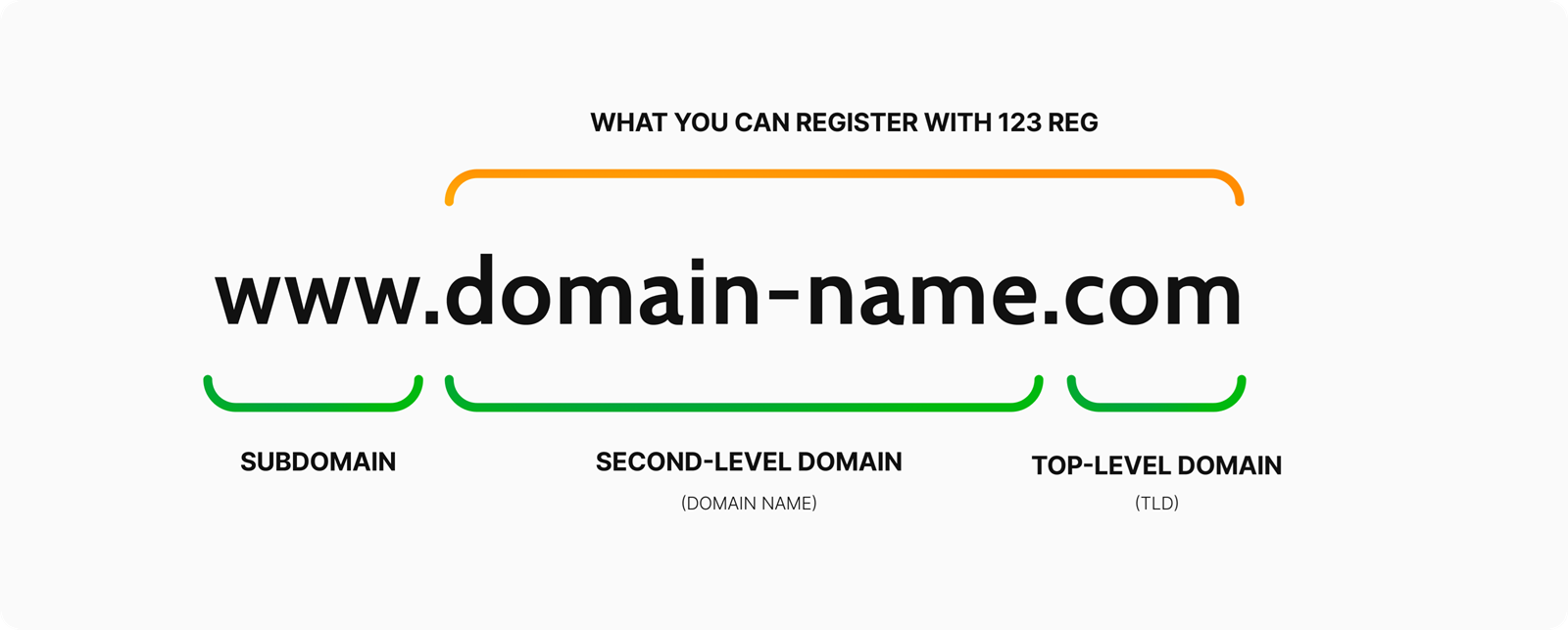
Once it’s yours, you can build on it. Create a professional website with 123 Reg Website Builder, or go further with Managed WordPress or Web Hosting if you want more flexibility and control over how your site grows.
The same domain lets you set up a matching professional email address, like hello@your-big-idea.co.uk — one of the most essential ways to build trust online.
For more, check out: What is a Domain Name? A Beginner’s Guide to Domains
Why domains matter even more for UK businesses
Buying a domain isn’t quite the same everywhere. A few things make the UK a bit different.
British buyers really care about local trust signals. UK shoppers are a cautious bunch online. They’ll often check for a UK address or a familiar domain ending before they trust a site with their card details.
A .co.uk or .uk ending says “British business” at a glance. That can matter almost as much as the name itself, especially for local trades or regulated industries like finance and healthcare.
Regional identity is a real thing here. The UK isn’t one single market online. A business trading mainly in Wales, Scotland, or London has good reason to say so in its domain. Local options like .wales, .scot, and .london make that easy to do.
Nominet runs the show. Unlike .com, which is open for anyone to register through any of hundreds of accredited registrars worldwide, .co.uk and .uk are managed by Nominet. It’s a not-for-profit that’s run the registry since 1996. You can’t purchase directly from Nominet; you need to buy through an accredited registrar like 123 Reg. It’s Nominet, however, who sets the domain rules and keeps the whole space tidy.
Brexit affected domain choices for some UK businesses. Since 2019, .eu domains have needed a registrant based in the EU or EEA. That pushed some UK businesses back toward .uk and .co.uk as their main address.
Registrars compete hard for your business. 123 Reg, GoDaddy, and loads more all want your custom. Which is great news for consumer domain prices.
UK domain landscape — Snapshot
- ✓.co.uk is the UK’s most popular domain extension, with millions of businesses and individuals using it for their websites.
- ✓More than 100,000 new .uk domains are typically registered every month, showing the shorter option is now widely trusted. There are over 10.44 million .uk domains, according to Nominet.
- ✓68% of British businesses have a website according to the Office for National Statistics, meaning most are already up and running online in some form.
- ✓That still leaves 32% without a website, which means plenty of opportunity for businesses yet to get online and reach more customers.
- ✓Small businesses make up the vast majority of the UK business landscape. Official ONS Statistics show millions of businesses operating across the country, with most being small enterprises.
- ✓The growth isn’t limited to the UK either. Globally, there were 364.3 million domain names registered by the end of 2024 — up 1.2% year on year, according to Verisign.
How to register a domain name in the UK
Registering a domain name is easier than you might think. Put simply, you just need to choose a name, check its availability, and register it through a trusted UK domains provider like 123 Reg.
1. Search for your domain
Head to the domain search and type in the name you’d like. You’ll instantly see if it’s available, plus suggested alternatives. So if your-big-idea.co.uk is taken, you should still be able to grab your-big-idea.uk, your-big-idea.shop, or another option.
Not sure where to start? Our AI domain search can generate ideas based on a short description of your business and what you do.
2. Pick one and add it to your basket
Add the domain to your basket and complete the payment process. You’ll also choose how long to register it for, anywhere from one to ten years. With 123 Reg, you can secure a new domain for as little as 1p for the first year, or even get one free with many annual hosting plans.
3. Add hosting and get it connected
You’ll need a hosting plan to get your website online. If you registered your domain as part of a plan like Website Builder or Managed WordPress Hosting, it’s typically connected for you, so there’s nothing else for you to do. If not, it’s easy to “point” your domain to your website and inbox by updating the DNS settings in your 123 Reg control panel.
What details do you need to register a domain?
Registering a domain in the UK is easy. You don’t need much to get started!
Most registrars will ask for just a few key pieces of contact information so they can set up your account and manage your domain correctly.
✓ Your full name or the legal name of your business
✓ An email address where renewal and admin notices will be sent
✓ Contact details — usually phone number and postal address
✓ Payment details — usually a debit/credit card, both for initial registration and future renewal
For the .co.uk and .uk extentions and many others, that’s all you need. Unlike some country-code domains (like .de for Germany or .us for the USA) you don’t need to “prove” a UK presence to register a .co.uk or .uk domains (though you did at one point, until the rules changed in 1996!)
How long does it take to register a domain name?
In most cases it’s almost instant. Once you’ve checked out with 123 Reg, your domain is usually active within minutes and ready to use.
How to choose the right domain
Before you touch a registrar’s search box, it’s worth a think. Get this bit right and you’ll save yourself a messy rebrand later. It doesn’t need to be perfect, but it should at least be easy to say and simple for customers to remember.
✓ Match it to your business name if you can
Sounds obvious, but it’s the biggest factor in the long run. Keep your company name, trading name, and domain lined up and people will find you without a second guess.
✓ Decide how “UK-focused” you want your domain to be
A domain ending is a small bit of marketing in itself. Selling only to UK customers? A UK ending does real work for you. Going after international customers from day one? .com wins on recognition, and still works at home.
✓ Keep it short and easy to say out loud
This matters more than you’d think in the UK. Domains get read aloud a lot: over the phone, on the radio, painted on the side of a van. If you’d struggle to dictate it clearly, so will your customers.
✓ Skip hyphens and numbers if you can help it
Harder to say, easier to mistype. A bit like a car with a slightly odd number plate. Nothing technically wrong, just not quite right.
✓ Think about the whole family of endings
Loads of UK businesses grab more than one, say both .co.uk and .com, just to protect the brand and redirect traffic. Even if only one is the “main” address. More on this coming up.
Choosing the right domain ending
Domain endings help shape how your website looks and feels. The right one depends on your audience, your industry, and the image you want to give.
There are also more specific options worth a look, like .shop or .store, which spell out exactly what your site’s about right in the URL. They’re a nice way to stand out, though they’re less familiar to some shoppers than the classics.
With 400+ domain endings to choose from at 123 Reg, you’re sure to find one that matches your brand and business. Just try to keep it simple and easy to remember. The last thing you want is customers typing in the wrong web address and landing somewhere else entirely.
See also: What is a Top-Level Domain (TLD)? and How to Choose the Best Domain Ending in 2026
UK-focused domain extensions: Which one fits your business?
This is where the UK market really stands out. Alongside .com, .net, and .org, the UK has its own set of nation-specific endings worth knowing about. Each one carries a slightly different flavour depending on where and who you’re trying to reach.
.co.uk
Still the go-to for most UK businesses and the most recognised UK ending out there. Says “commercial, UK-based” without needing to explain itself. If you only grab one UK domain, make it this one.
.uk
A shorter, newer option from Nominet, launched in 2014. Works the same as .co.uk but drops a segment. Plenty of businesses grab both, since .co.uk holders get first dibs on the matching .uk name.
.london
Great for businesses trading in or tied to the capital. Popular with hospitality, property, creative agencies, and tourism brands who want the city name doing some of the marketing for them.
.wales and .cymru
A pair for Welsh national identity, with .cymru aimed squarely at Welsh-language and cultural branding. Both sit under Nominet, and both are a strong shout if you trade in or are proud to be from Wales.
.scot
The Scottish equivalent. Popular with tourism, food and drink, and anything wanting to wear its Scottish identity loud and proud.
For more, check out: .com vs .co.uk – Which Works Best for Your British Business?
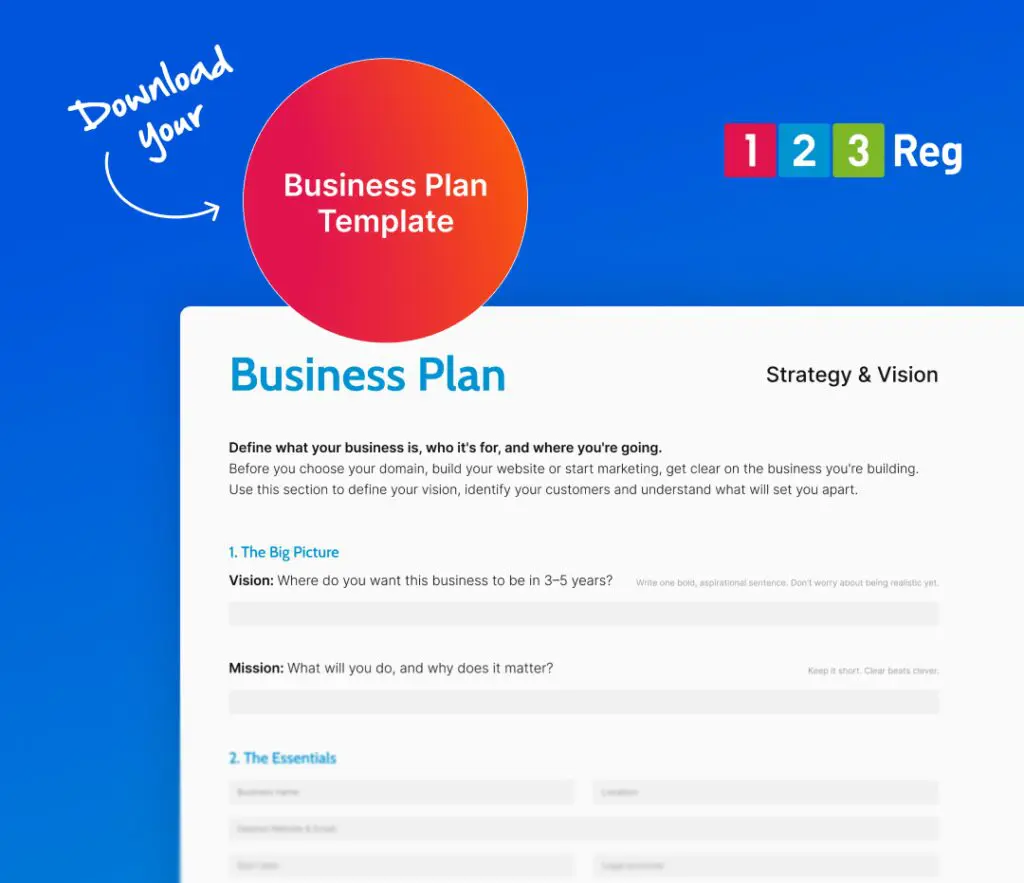
Our Free Business Plan Template helps you map out your next steps, so you start with a clear plan — download it here.
How much does a UK domain cost
Prices vary depending on the extension and provider, but common ones like .co.uk and .com are usually very affordable to get hold of, especially with 123 Reg.
If you’re looking for an example:
☐ .co.uk domains at 123 Reg typically start from around £3.99 for the first year, making them one of the most popular choices for UK businesses.
☐ .uk domains are often available for just £0.01 for the first year, giving you a shorter, snappier alternative to .co.uk at a very low entry price.
☐ .com domains can also be heavily discounted, with some promotions offering .com for as little as £0.01 for the first year when you commit to a multi‑year term.
It’s important to remember that promotional prices usually apply only to the first year. After that, domains renew at the standard renewal rate.
Can you get a domain name for free?
Yes, with 123 Reg! Most annual hosting plans, including Website Builder and Managed WordPress Hosting, come with a free .co.uk, .uk, or .com domain (and more) for the first year.
For more, check out: How To Get a Free Domain Name
Can you buy multiple domain extensions?
Yes, and it can actually be a smart move if you want to protect your brand. Buying multiple domains can:
✓ Help stop others using similar names
✓ Keep your brand consistent
✓ Cover different markets or versions of your name
Where to buy a domain name in the UK
In the UK, you’ll need to buy a domain through an accredited registrar, 123 Reg and GoDaddy are two of the best-known names, or through a hosting provider offering domains as part of a wider package.
Prices and perks vary between registrars, so it’s worth comparing not just the name search but what you actually get bundled in.
With 123 Reg, for example, most annual hosting plans, including Website Builder and Managed WordPress Hosting, come with a FREE .co.uk, .uk, or .com domain (and more) for the first year. That means you’re not paying twice over for two separate things — your domain and your hosting are sorted together.
What to do after buying your domain
Connect your domain to your site (if it’s not already)
To connect your domain to a website, you’ll update the DNS records in your registrar’s control panel to point to your hosting provider. Most commonly, this means updating your A record (which points to your host’s IP address) or your nameservers entirely, which hands DNS control over to your hosting provider.
Your hosting provider will give you the exact values you need, and most have step-by-step guides for doing this. Changes to DNS can take anywhere from a few minutes to 48 hours to fully propagate, though it’s usually much faster.
See also: How Do I Connect My Domain to My Website? and How to Make a Website with Website Builder
Create a professional email address
Once your domain’s connected, you can set up an email address to match, like hello@yourbusiness.co.uk instead of a generic Gmail or Outlook one. It makes a big difference to how your business comes across.
123 Reg email hosting is a great option. Again, if you purchased your domain as part of a 123 Reg plan, there’s a good chance your email is connected already.
Just remember: if you’ve purchased more than one domain, choose the one that best represents your business for your email address and branding, and stick to it.

Learn more about 123 Reg Professional Email
Keep your domain secure and renewed
Remember that a domain name is never a one-off purchase. They’re registered for a set period (usually one to ten years) and needs to be renewed to stay yours.
If you miss a renewal and there’s a real risk someone else could register it the moment it lapses (along with any website or email built on it!).
The easiest fix is to turn on auto-renew in your 123 Reg account, so your domain renews automatically each year without you needing to remember.
Ultimate Domain Protection gives you the added safety net of a holding period so that, if a payment does fail for some reason, the domain is held for 90-days.
Ready to go?
You’ve got everything you need to find the right domain name and get it registered. Start with a search. Head to a domain registrar, type in your business name or a few variations, and see what’s available. I
If your first choice is taken, don’t settle for something messy. Take a bit of time to find a name that’s clean, memorable, and available in the extension that suits you best.

FAQ
What details do you need to register a domain?
You’ll usually just need your name, an email address, and your business name if you have one. Some registrars also ask for a contact address, mainly so they can verify who owns the domain. It only takes a minute or two to fill in.
How long does it take to register a domain name?
It’s almost instant. Once you’ve paid, your domain is usually active within minutes and ready to connect to a website or email. In rare cases it can take a little longer to fully update everywhere, but it’s the exception rather than the rule.
What’s the easiest way to build a website?
123 Reg Website Builder is the fastest route for most people. It handles hosting, design, and the technical stuff so you just add your content. WordPress is more powerful and the most widely used platform out there, but it takes a bit more time to learn.
Should you use keywords in your domain name?
Sometimes, if it feels natural. A keyword can help explain what you do at a glance, but it shouldn’t make the name long or clunky. As a rule, your brand name should come first, with a keyword only added if it fits neatly alongside it.
Is a free domain really free?
With 123 Reg hosting plans, your domain is free for the first year. After that, it renews at the standard renewal rate, so it’s worth checking the ongoing cost when choosing your plan. It’s a simple way to get your website online while keeping your domain and hosting together in one place.
Can you buy multiple domain extensions?
Yes, and it’s often a smart move if you want to protect your brand. Registering a few versions, like .co.uk, .uk and .com, stops competitors or opportunists using a similar name, and keeps your branding consistent everywhere. Many businesses point them all at the same website.
What affects the price of a domain?
The extension makes the biggest difference, with newer or more sought-after endings usually costing more than .co.uk or .com. Whether it’s a fresh registration or a premium domain also plays a part, as does any offer or bundle you get through a hosting or website plan.
Should you add domain privacy protection?
Yes, it’s worth having. Without it, your name, address and email are visible to anyone who looks up your domain in the public WHOIS directory. If you didn’t add it when you registered, most registrars let you switch it on later from your account for a small yearly fee.
How do you renew your domain name?
Domains are registered for a set period, usually one to ten years, and need renewing before they expire. If you miss the date, the domain can become available for someone else to register, so it’s worth turning on auto-renewal and keeping your payment details up to date.
Should UK businesses choose .co.uk or .com?
If most of your customers are in the UK, .co.uk is usually the more natural choice and helps build trust locally. If you’re planning to sell or grow internationally, .com is worth considering too. If you register both, choose the preferred one as the main domain for your email address and branding.