
You’ve got a name in mind for your business, project, or side hustle. The next step is simple: find out if it’s available to register.
Checking takes seconds (literally) and even if your first choice is already taken, you’ve got more options than you might think.
This guide walks you through how to check a domain name, along with a few practical ways to handle it if your first choice is already taken.
Key takeaways
- ☑︎ Your domain name matters. It’s your first impression online, and getting it right is worth a little time upfront.
- ☑︎ More is available than you think. With millions of domains still unregistered and hundreds of extensions to choose from, there’s likely something great with your name on it.
- ☑︎ Taken doesn’t mean gone. Different extensions, the secondary market, and backorder services all give you options if your first choice is already registered.
- ☑︎ Your extension is part of your brand. For UK businesses, .co.uk or .uk could beat .com for trust and relevance with local customers.
- ☑︎ If you find the right one, register your domain now. Domains move fast, and securing yours today costs very little compared to chasing it down later.
What is a domain name?
A domain name is your place on the internet.
It’s often the first thing a visitor sees, and it shapes how they feel about your business before they’ve even clicked.
That’s why it matters to choose a name that feels right for what you’re doing — be it something brand-led, keyword-based, or just simple and memorable.
And it’s easy to register a domain in just a few steps.
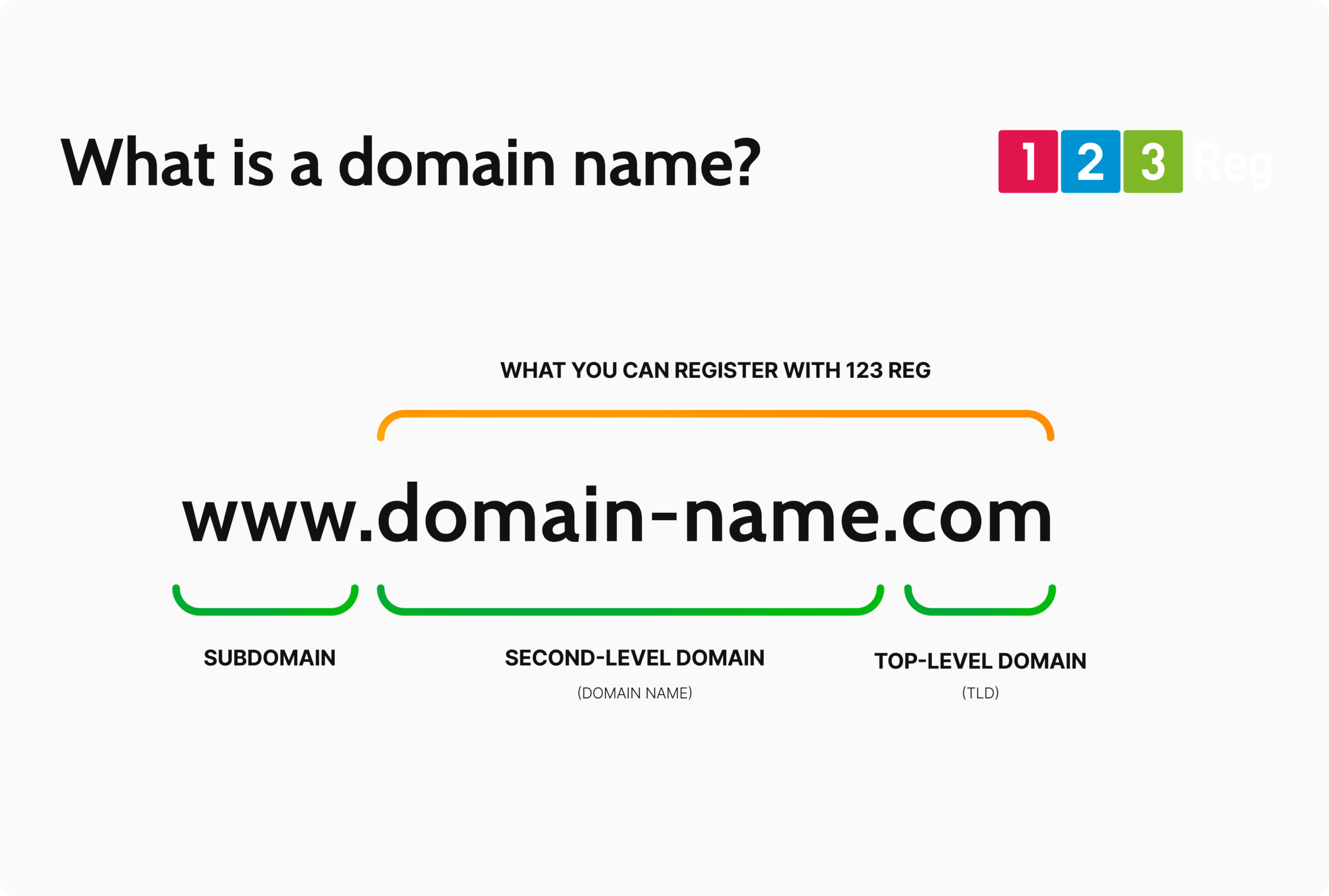
A domain name has two main parts you can register:
☐ The Second-Level Domain (SLD) — more simply the “the middle bit”, this is the first part you get to choose. In www.123-reg.co.uk, for example, that’s the “123-reg”
☐ The Top-Level Domain (TLD) — this is the ending or extension, like “.co.uk”.
123 Reg offers a choice of 400+ extensions, so you’re sure to find one that fits what you do perfectly.
Which TLD should you choose?
That ending does more than you might think. A .co.uk feels local and familiar in the UK, while .com carries a more global feel.
Beyond those, there’s a whole world of newer extensions worth considering. .ai has become popular with tech and AI-focused projects, .shop works well for ecommerce, and something like .studio or .agency can tell people exactly what you do before they’ve even visited your site.
Once you’ve got a name in mind, you can easily do a quick domain search to check it’s available. If it is, you can move fast to domain registration before someone else takes it.
How do I check if a domain name is available?
The easiest way to find a domain is to use the 123 Reg Domain Search.
1. Enter your name — Just the name or idea itself, optionally with an extension (like .co.uk) if you’ve already got one in mind
2. Review your results — you’ll see what’s available, what’s taken, and what alternatives are on the table
3. Register it! — if the domain is free, you can buy it and register it on the spot.
There are millions of domains available (123 Reg has over 3 million!) and you might be surprised just how many strong options are out there waiting.
How much does a domain cost?
Prices start from as little as 1p for the first year. In fact, you can even get a free domain name included with most annual 123 Reg hosting plans (like Website Builder) or professional email.
Try a few variations and check different extensions — sometimes the same idea works better with a different ending than you first expect.
If you find one you like, don’t sit on it. Domains can disappear quickly, and securing yours now costs very little compared to trying to buy it back later.
For more help weighing up domain endings, check out: What is a Top-Level Domain? and How to Choose the Best Domain Ending in 2026
What will the domain search results tell me?
When you run a search, you’ll get one of a few outcomes:
✓ Available
The domain is free and ready to register. If you want it, it’s worth acting quickly. Popular names and newly released extensions can go fast.
✓ Available under a different extension
The .com might be gone, but the same name could still be free as a .co.uk, .uk, .online, .store, or one of hundreds of other extensions. For UK-based businesses especially, a .co.uk or .uk domain is often the stronger choice anyway.
✗ Taken
Currently registered to someone else. It’s not always the end of the road, though. See the next section for your options.
? Premium domain
Available to buy, but at a higher price than a standard registration. These are typically short, memorable, or high-demand names. More on those shortly.
For more, check out: What is a Domain Name? A Beginner’s Guide to Domains
Quick checks before you buy a domain
Make sure it works long-term
Keep it short, easy to say, and easy to spell. Avoid hyphens and numbers where you can.
Check it fits your brand
Have a quick look on Google and social media to see if the name’s already in use. If you’re planning to build a brand around it, a quick UK IPO trademark search can help too.
Be flexible if needed
If your first choice isn’t available, try a different extension like .co.uk or .uk, or tweak the wording slightly. You might land on something better.
Register it while it’s available
Once you’ve found the right name, don’t leave it too long — domains can get snapped up quickly, and prices are often very low for the first year.
Once your domain is live, find next steps here: I Have a Domain, Now What?
What if a domain name is unavailable?
It doesn’t always mean the name is off the table.
Start by checking whether it’s free under a different extension. If your-big-idea.com is gone, your-big-idea.co.uk or your-big-idea.uk might be completely free.
It’s also worth playing with the name itself — adding a word, shortening it, or trying a different angle can open up a lot of options.
What if my preferred TLD is taken but others are free?
A .com is not the only option that works, and for many businesses it’s not even the most appropriate one.
If you’re trading in the UK, a .co.uk or .uk signals that straight away to your customers and can build more trust with a local audience. Extensions like .studio, .shop, .agency, or .tech can work just as well when they reinforce what you do.
The key is choosing something that feels natural for your brand, not like a consolation prize. A strong name on the right extension will always outperform a weak name on a .com.
It’s also worth thinking about brand protection. Registering yourbusiness.co.uk, yourbusiness.uk, and if budget allows yourbusiness.com, then pointing them all to one site, means you won’t lose traffic to typos or competitors as your brand grows.
Reverse branding: start from what’s available!
When the perfect name keeps disappearing, flip the process. Start with an available domain and build a brand around it. Plenty of big brands have done exactly that, and you might even end up with a name that’s more memorable and original.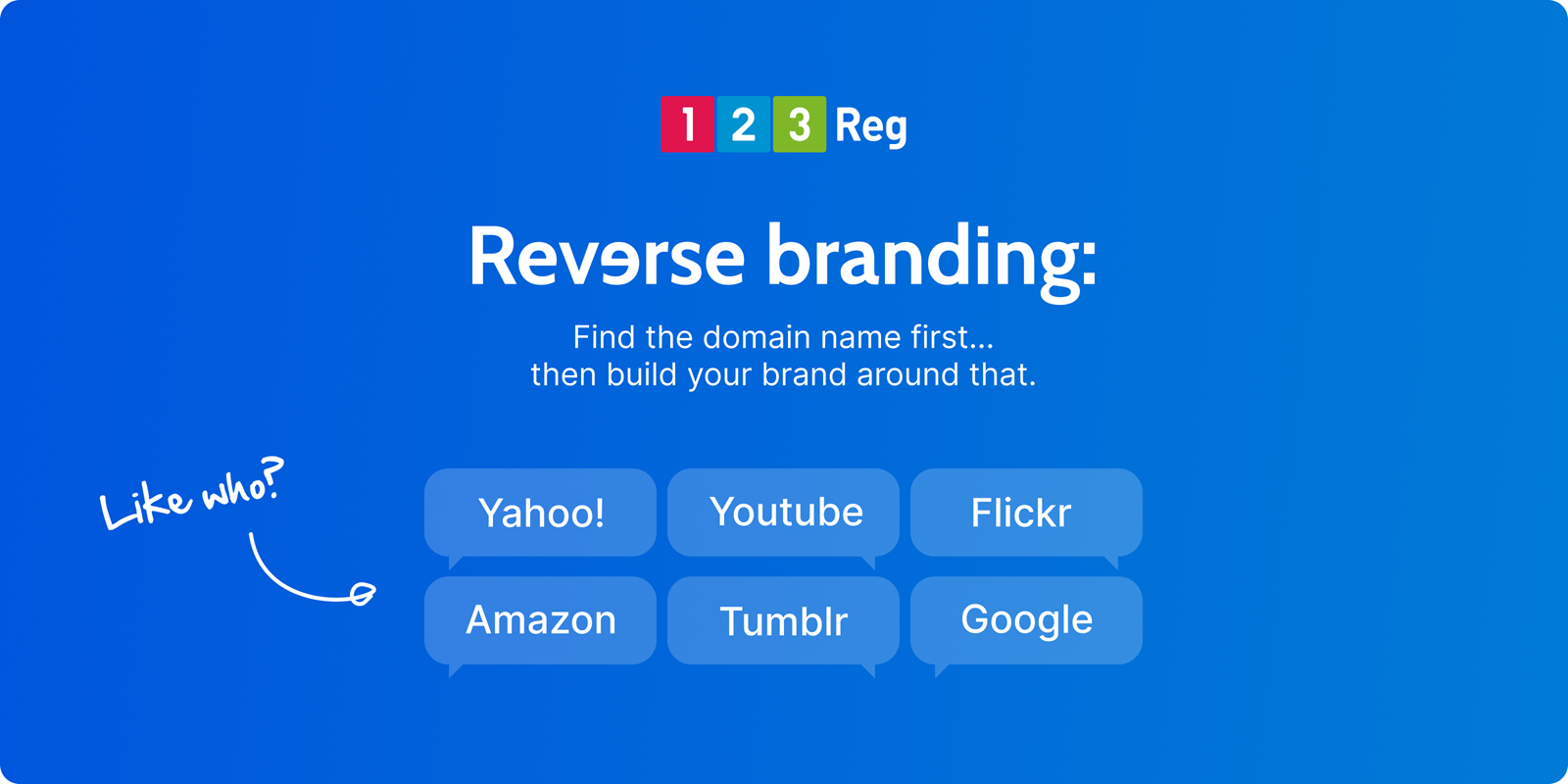
Are there domain names you can’t register?
Yes, some names are off the table regardless of what a search shows. The most common reasons:
Characters and formatting — domain names can only contain letters, numbers, and hyphens. No spaces, no special characters, and a hyphen can’t appear at the start or end of a name.
Single characters and certain two-letter combinations are reserved at registry level to avoid conflicts with country codes and technical infrastructure.
Country code TLDs (ccTLDs) — some TLDs restrict who can register them. A .de domain requires a German address, for example, and some others are limited to residents or businesses in that country.
Finally, Trademarked terms can be blocked, if a name is trademarked, the brand owner may have the right to block others from registering it as a domain.
If a name keeps coming back as unavailable with no obvious reason, it’s likely falling into one of these categories.
Can I still get a domain name that’s already taken?
Sometimes, yes. If the exact name and extension you want is registered, the secondary market is worth exploring. Some domains are listed for resale at a set price, while others require negotiation with the current owner.
You could also wait it out. Backorder services let you queue up a registration attempt on a domain that’s close to expiry, so if the current owner doesn’t renew, you’re first in line. It’s not guaranteed, but it costs little to try.
It’s also worth knowing that expired domains don’t become available straight away. There’s a grace period for the original owner to renew, followed by a redemption window before the name returns to the open market. That process can take several weeks.
Can I check who owns a domain name?
If a domain is taken and you want to know who owns it, a WHOIS lookup is the place to start. WHOIS is a publicly accessible database that holds registration details for domain names, including the owner’s contact information and when the domain is due to expire.
One thing worth knowing: many registrants protect their details using a service like 123 Reg’s Domain Ownership Protection.
Without it, your name, address, and email are publicly visible to anyone who runs a search — which opens the door to spam, phishing attempts, and other unwanted attention. It’s a small addition at registration that’s well worth ticking.
For more, check out: What is WHOIS?
What are Premium Domains?
Premium Domains are names that are available to register but priced much higher than a standard registration. Think short, punchy, easy-to-spell names with obvious commercial appeal, like loans.co.uk or shop.uk.
The higher price reflects demand: these are names that many businesses would want, and their value comes from being memorable, credible, and often strong for SEO.
Worth it? It depends. For an established business looking to rebrand or move into a new market, the right premium name can be a smart investment. For most people just starting out, a well-chosen standard domain at a fraction of the cost will do the job just as well.
See also: The Most Expensive Domain Names Ever Sold
Wrap up
Checking whether a domain name is available is the easiest part of getting your business online. It takes seconds, and with over 400 extensions to choose from, there’s almost always a good option waiting even if your first choice is gone. But don’t overthink it. A relevant, memorable name on the right extension will serve your business well. And once it’s registered, it’s yours.

Search for your domain today with 123 Reg and take the first step towards getting your idea online.
FAQ
Do I need a .com, or will a .co.uk do?
For most UK businesses, a .co.uk or .uk domain is the stronger choice. It signals straight away that you’re a British business, and UK customers are completely comfortable with it. A .com is worth having if you’re trading internationally, but it’s not a requirement.
For more, check out: .com vs .co.uk – Which Works Best for Your British Business?
How long does it take to register a domain name?
Registration is instant. Once you’ve completed your purchase through 123 Reg, the domain is yours and can be set up straight away.
How long does it take for a domain to become available after it expires?
Typically between 30 and 90 days. There’s a grace period for the original owner to renew, followed by a redemption window before the domain is released. If you’re waiting on a specific name, a backorder service puts you in the queue the moment it drops.
Can I reserve a domain name before registering it?
No. The only way to secure a domain is to register it. If a new extension is launching, you may be able to apply during the Landrush period before general availability, but there are no reservations on the standard market.
How many domain names can I register?
As many as you like. Many businesses register their name across several extensions to protect their brand and avoid losing traffic to typos or competitors.
What’s the difference between a domain being unavailable and being restricted?
An unavailable domain is registered by someone else and could become free again in future. A restricted domain cannot be registered by the public at all, regardless of availability, as it’s held back at registry or ICANN level.
What if someone registers a domain using my business name?
If your business name is trademarked and the domain has been registered in bad faith, you may be able to challenge it through the UDRP process. It’s worth taking legal advice if you think your brand is being misused.
What if someone has registered my brand name as a domain?
If you hold a trademark and someone has registered a domain in bad faith using your brand name, you may have grounds to dispute it through UDRP (Uniform Domain-Name Dispute-Resolution Policy). This is a formal process administered by ICANN that can result in the domain being transferred or cancelled.
It won’t apply to most small businesses, but it’s worth knowing the option exists, especially as your brand grows.
For more, see: Domain Names & Trademarks — A Guide for Your Online Brand
Can I get a domain name for free?
Yes! With select 123 Reg plans you can actually get a domain free domain for year one, including a .co.uk or .com!
To learn more, check out: How To Get a Free Domain Name